Electric Drive Solutions for Wheel Loader Applications
Electrification of wheel loaders places strong emphasis on traction performance, frequent load cycles, and high system robustness.
Compared with excavators, wheel loaders operate with more repetitive driving patterns, frequent start–stop cycles, and high traction forces during loading and hauling operations.
Synwyn Dynamics provides application-driven electric drive solutions for wheel loaders, focusing on system architecture, drivetrain integration, and duty-cycle-based design to balance performance, reliability, and cost.
Wheel Loader Functional Architecture
A typical electrified wheel loader includes the following main functional subsystems:
• Traction drive for vehicle movement
• Hydraulic pump drive for lifting and bucket functions
• Auxiliary systems such as cooling, steering, and accessories
Compared to excavators, wheel loaders generally feature fewer but higher-load actuators, with traction and hydraulic systems dominating overall energy consumption and thermal loading.
E-Drive System Configuration for Wheel Loader Applications
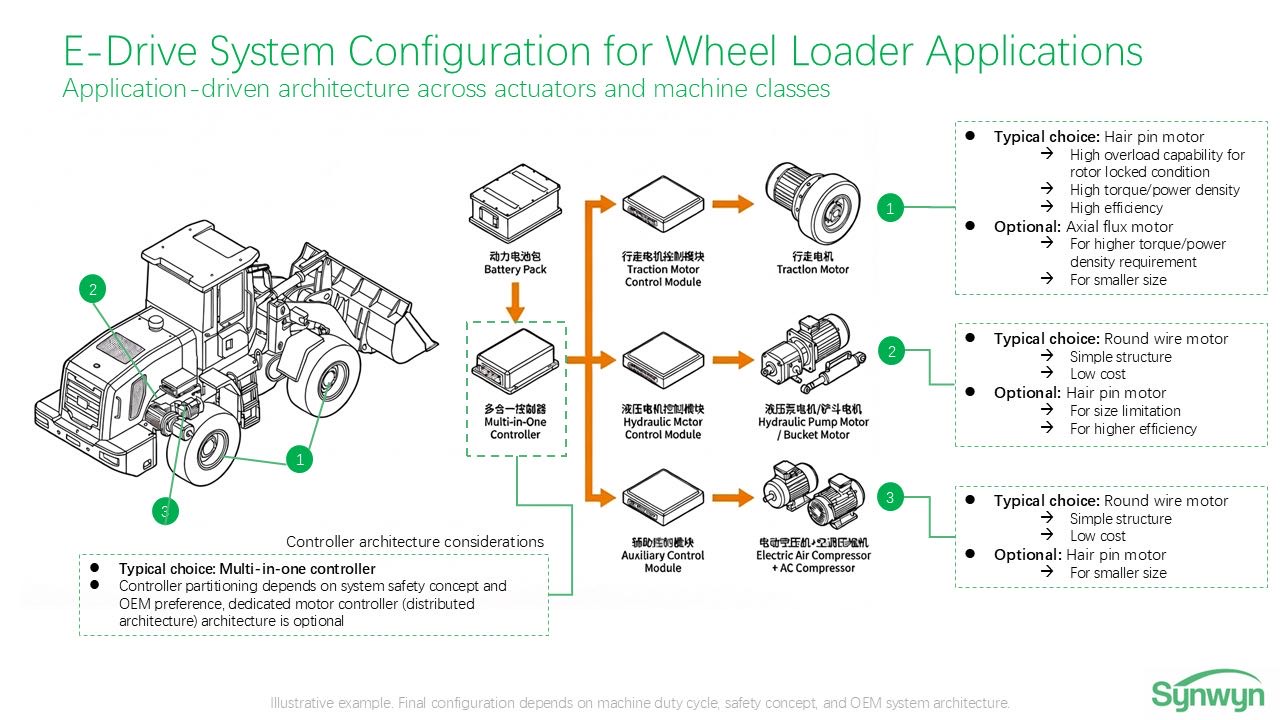
The following diagram illustrates a reference electric drive system configuration for wheel loader applications.
It highlights typical actuator functions, motor topology options, and controller architecture considerations at system level.
Final system configuration may vary depending on machine size, duty cycle, and OEM system architecture.
 System-Level Design Considerations
Traction-Oriented Drivetrain Design
Wheel loader performance is largely defined by traction capability under heavy load.
Electric drive systems must deliver high torque at low speed, withstand frequent overload conditions, and provide smooth controllability during loading cycles.
Hydraulic System Electrification
Electrified hydraulic pump drives enable improved energy efficiency and controllability compared with traditional engine-driven systems.
System configuration depends on hydraulic demand profiles, operating cycles, and coordination with traction drives.
Architecture and Integration Strategy
Key system-level considerations include:
• Direct drive versus geared drivetrain concepts
• Centralized versus integrated controller architectures
• Power distribution and thermal management under repetitive load cycles
These architecture decisions strongly influence system efficiency, durability, and total cost of ownership.
Solution Scope
Typical Solution Elements
• Electric traction drive architectures for wheel loaders
• Electrified hydraulic pump drive solutions
• Coordinated control of traction and hydraulic systems
• Scalable system configurations for different machine sizes
Solutions are provided as reference architectures and configurations, with final implementation adapted to specific machine platforms, duty cycles, and OEM requirements.
From Reference Architecture to Project Implementation
Wheel loader solutions range from recommended system architectures to project-specific implementations and validated configurations, supporting OEMs and system integrators from concept definition to industrialization.
In wheel loader electrification, traction performance and system robustness are defined by architecture-level decisions.
